Garlic and Onions with IBS — Powder, Infused Oil, Allicin, and Substitutes
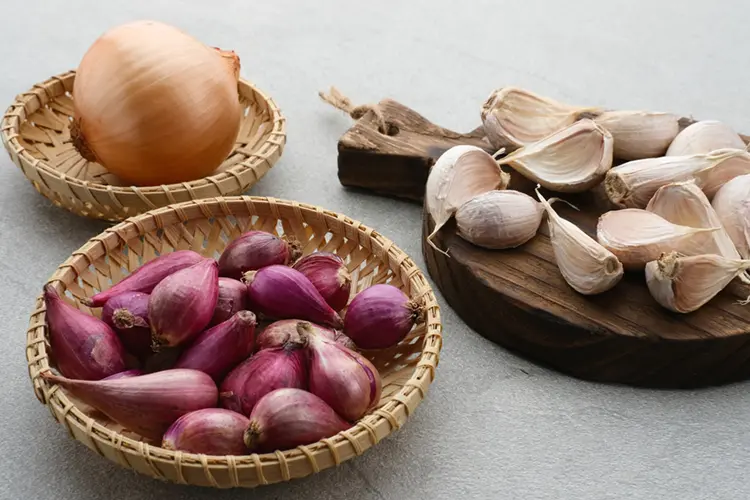
Garlic and onion are two of the most flavourful ingredients in cooking — and two of the most reliable IBS triggers. Both are very high in fructans, the fermentable carbohydrate at the heart of the low-FODMAP approach to IBS management. But not all forms of garlic and onion behave the same way. Garlic powder, raw garlic, cooked garlic, garlic-infused oil and allicin supplements have meaningfully different FODMAP profiles — and understanding those differences is the difference between avoiding these foods entirely and continuing to cook with their flavour. This guide covers the evidence on each form, onion's often-underestimated role as an IBS trigger, wild garlic, allicin supplements, and the most practical low-FODMAP substitutes for Irish kitchens.
Why Garlic and Onion Trigger IBS — The Fructan Mechanism
The problem with both garlic and onion is a specific type of carbohydrate called fructans — chains of fructose molecules that the human digestive system cannot break down. There is no enzyme in the human small intestine capable of cleaving fructan bonds. As a result, fructans pass through the small intestine essentially intact and arrive in the large intestine, where the resident gut bacteria ferment them rapidly.
That fermentation produces large volumes of gas — hydrogen, carbon dioxide and methane — in a short period of time. In people with IBS, whose gut is more sensitive to luminal distension and whose motility is already dysregulated, this gas production triggers a familiar cascade of symptoms: bloating, abdominal cramping, urgency and altered bowel habit.
Fructans are one of the five FODMAP groups — Fermentable Oligosaccharides, Disaccharides, Monosaccharides and Polyols — that the low-FODMAP elimination diet targets. Among the fructan-containing foods, garlic and onion sit at the extreme high end. A 2018 study published in Gastroenterology by Biesiekierski et al. specifically demonstrated that fructans, rather than gluten, were responsible for gastrointestinal symptoms in people identifying as non-coeliac gluten sensitive — a finding that illustrates how potent a trigger fructans can be even at moderate doses.
For a full explanation of the low-FODMAP framework and how the elimination and reintroduction phases work, see our guide to the low-FODMAP diet in Ireland.
Onion and IBS — Often the Bigger Problem
Garlic tends to get more attention as an IBS trigger, but onion is arguably the more significant one for most people — primarily because it appears in far more dishes and in larger quantities. A single medium brown onion contains a very high fructan load, and onion is a base ingredient in the majority of savoury cooking traditions.
| Onion Type | FODMAP Status | Notes |
|---|---|---|
| Brown onion (raw or cooked) | High | Very high fructan content — one of the highest-FODMAP foods tested |
| White onion | High | Similar fructan load to brown onion |
| Red onion | High | High-FODMAP — also contains fructose at higher serving sizes |
| Shallots | High | High-FODMAP; often used in French cooking as a garlic-onion base |
| Spring onion — white bulb | High | The bulb end is high-FODMAP |
| Spring onion — green tops | Low | Green tops are low-FODMAP — the key exception to the onion rule |
| Leek — white/light green part | High | High-FODMAP; commonly used in Irish soups and stews |
| Leek — dark green tops | Low | Low-FODMAP in reasonable quantities — use the darker green leaves only |
An important practical point: onion does not become safe when cooked. Like garlic, onion fructans are heat-stable. A caramelised onion base, a slow-cooked casserole with onion, or an onion-heavy soup all retain their full fructan content. This is one of the most common sources of unintentional FODMAP exposure for people with IBS who are attempting dietary management.
Similarly, onion in stocks and broths transfers fructans into the liquid. A stock made with whole onion or onion skins is not low-FODMAP, even after straining — fructans are water-soluble and leach readily into the cooking liquid. Low-FODMAP stock requires onion-free preparation, which in practice means making your own or sourcing specifically labelled low-FODMAP commercial stocks.
Garlic Powder and Onion Powder — Are They Worse Than Fresh?
A common question is whether dehydrated forms — garlic powder and onion powder — are safer than the fresh versions, on the assumption that processing might reduce fructan content. The evidence points in the opposite direction.
Dehydration concentrates fructans. When fresh garlic or onion is dried and ground into powder, the water is removed but the fructans remain. The result is a higher fructan load by weight than the equivalent amount of fresh allium. Monash University classifies both garlic powder and onion powder as high-FODMAP, with no identified safe serving size.
This matters particularly because garlic powder and onion powder are prevalent in processed and packaged foods — spice blends, seasoning sachets, stock cubes, ready meals and crisps frequently contain one or both. For people with IBS trying to manage symptoms through diet, ingredient label reading is essential. "Garlic powder", "onion powder", "garlic salt", "onion salt" and "mixed spice" (which often contains both) should all be treated as high-FODMAP ingredients.
| Garlic Form | FODMAP Status | Relative Fructan Load |
|---|---|---|
| Raw garlic clove | High | High |
| Cooked garlic (any method) | High | High — fructans are heat-stable |
| Garlic powder | High | Very high — concentrated by dehydration |
| Garlic salt | High | Very high — typically 60–70% garlic powder |
| Wild garlic (Allium ursinum) | Unconfirmed | Likely lower than cultivated garlic — not formally Monash-tested |
| Garlic-infused oil | Low | Negligible — fructans do not transfer into oil |
| Aged garlic extract (supplement) | Reduced | Lower than raw garlic — processing reduces fructan content |
Wild Garlic — Is It Lower FODMAP?
Wild garlic (Allium ursinum) is a native Irish plant, widespread in damp woodland from March to May, and increasingly popular in seasonal cooking. It is a different species from cultivated garlic (Allium sativum), and its carbohydrate storage profile differs.
Cultivated garlic stores carbohydrates primarily as fructans in its bulb. Wild garlic, which is a leafy plant harvested for its leaves and flowers rather than a bulb, stores carbohydrates differently and is believed to have a lower fructan content. Anecdotal reports from people with IBS suggest it is better tolerated than cultivated garlic, and some practitioners working with low-FODMAP diets have noted this informally.
However, Monash University has not formally tested and classified wild garlic as of mid-2026. It does not appear in the Monash FODMAP app with a confirmed serving size. This means it cannot be recommended as low-FODMAP with confidence, and anyone in the strict elimination phase of the low-FODMAP diet should treat it as unconfirmed and avoid it until reintroduction. For those past elimination who are testing personal tolerance, small amounts of wild garlic leaves may be worth trialling carefully.
Garlic-Infused Oil — The Key Practical Workaround
The most important thing to understand about garlic-infused oil is why it works — because it rests on a clear biochemical principle, not a compromise or approximation.
Fructans are water-soluble. They dissolve in water and in water-based liquids (including the watery contents of the gut), but they do not dissolve in fat. When garlic is steeped in oil, the fat-soluble flavour compounds — primarily allicin breakdown products including diallyl disulfide and diallyl trisulfide — transfer freely into the oil. The fructans remain in the garlic solids and do not leach into the oil phase at all.
The result is an oil that carries the characteristic flavour and aroma of garlic without any of the fermentable carbohydrates responsible for IBS symptoms. Monash University has tested commercial garlic-infused oils and confirmed they are low-FODMAP at a standard serving of one tablespoon. This is not a small-serving workaround — the low-FODMAP classification holds at normal cooking quantities.
The same principle applies to onion-infused oil. Onion steeped in oil transfers flavour without fructans, and commercially produced onion-infused oils are also classified as low-FODMAP by Monash.
Food Safety: Homemade vs Commercial Infused Oil
One important distinction: commercially produced garlic-infused oil and homemade garlic oil are not equivalent from a food safety perspective. Fresh garlic submerged in oil creates anaerobic (oxygen-free) conditions that can support the growth of Clostridium botulinum — the bacterium that produces botulinum toxin. This risk is real and has caused documented cases of botulism from improperly stored homemade garlic oil.
Commercial garlic-infused oils are produced under controlled conditions that prevent this risk — typically through acidification of the garlic before infusion, or by using dried rather than fresh garlic. If you want to make garlic-infused oil at home, prepare it fresh, use it immediately, and do not store it. For everyday cooking use, commercially produced infused oil is the safer and more practical choice.
Allicin Supplements and Aged Garlic Extract — What the Research Shows
Allicin is the principal bioactive organosulfur compound in garlic, produced enzymatically when raw garlic is crushed or chopped. It is responsible for garlic's characteristic pungent smell and has attracted significant research interest for its antimicrobial, antifungal and prebiotic properties. For people with IBS, the question is whether allicin or garlic-derived supplements can deliver gut health benefits without the fructan load that makes whole garlic problematic.
The key point is that allicin itself is not a FODMAP. It is an organosulfur compound, not a fermentable carbohydrate. The symptom-triggering component of garlic is its fructan content — not its allicin, its flavour compounds or its volatile sulfur molecules. This means that garlic-derived supplements that retain allicin but reduce or eliminate fructan content are theoretically tolerable for IBS, and in practice appear to be better tolerated than raw garlic or garlic powder supplements.
Aged Garlic Extract (AGE)
Aged garlic extract is produced by cold-aging raw garlic in aqueous ethanol for up to 20 months. The prolonged aging process converts harsh, unstable organosulfur compounds — including allicin itself — into more stable, water-soluble derivatives including S-allylcysteine (SAC) and S-allylmercaptocysteine (SAMC). These aged compounds retain biological activity while being gentler on the gut.
Critically for IBS, the aging process also significantly degrades fructan content. A 2018 randomised controlled trial published in Experimental and Therapeutic Medicine (Ried et al.) examined aged garlic extract's effects on the human gut microbiome. The trial found that 90 days of AGE supplementation produced a significant increase in Lactobacillus and Bifidobacterium species, and a reduction in potentially pathogenic bacteria — findings consistent with a prebiotic mechanism. A 2023 systematic review published in Nutrients (Ansary et al.) examining garlic supplementation and gut microbiome across multiple trials similarly concluded that garlic-derived compounds, particularly AGE, beneficially modulate microbiome composition without the adverse symptom burden of whole garlic.
The clinical implication for IBS: aged garlic extract is the most evidence-backed and FODMAP-appropriate form of garlic supplementation for people with IBS who want to preserve the gut health benefits of garlic without triggering symptoms. It is available from health food stores and pharmacies in Ireland, typically under brand names such as Kyolic.
Stabilised Allicin Supplements
Allicin in raw garlic is highly unstable — it is produced only when the enzyme alliinase contacts alliin upon crushing, and degrades within hours. Stabilised allicin supplements are designed to deliver intact allicin to the gut by protecting it through encapsulation. These products are used by some practitioners specifically for gut dysbiosis and conditions overlapping with IBS, including small intestinal bacterial overgrowth (SIBO).
A 2014 review by Borlinghaus et al. in Foods documented allicin's broad antimicrobial activity against gut pathogens including Helicobacter pylori, Candida species and several bacteria implicated in SIBO. The relevance to IBS is indirect but meaningful: a subset of IBS patients — particularly those with IBS-D — have underlying SIBO, and the antimicrobial properties of allicin may address a root cause rather than just symptoms.
From a FODMAP perspective, stabilised allicin supplements vary by product. Most use a processed garlic extract rather than whole garlic powder, which significantly reduces fructan content. However, this varies by manufacturer, and it is worth checking the ingredients list for any filler or carrier ingredient that may contain garlic powder or onion powder.
What to Avoid: Garlic Powder Supplements
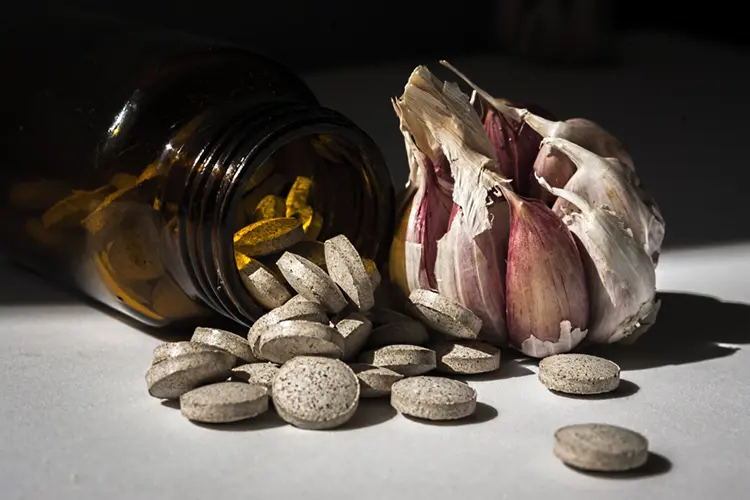
Garlic supplements based on dried garlic powder — the most common and cheapest form — are the least appropriate choice for IBS. Garlic powder retains its fructan content and is essentially a concentrated form of a high-FODMAP food in capsule form. These products are widely sold in pharmacies and health food stores and are not appropriate for people managing IBS through a low-FODMAP approach.
Low-FODMAP Substitutes for Garlic and Onion in Cooking
Eliminating garlic and onion entirely is a significant culinary adjustment. The following substitutes allow you to maintain the allium flavour profile that underlies most savoury cooking — without the fructan load.
| Substitute | FODMAP Status | Flavour Profile | Best Used In |
|---|---|---|---|
| Garlic-infused olive oil | Low | Garlic — full flavour | All cooked dishes, pasta, roasted vegetables, marinades, dressings |
| Onion-infused oil | Low | Mild onion — sweeter than raw | Cooked bases, soups, stews, rice dishes |
| Spring onion — green tops only | Low | Mild onion, fresh | Salads, stir-fries, soups, egg dishes, garnish |
| Leek — dark green tops only | Low | Mild onion, slightly earthy | Soups, stews, pasta sauces, cooked dishes |
| Chives | Low | Very mild onion, fresh | Cold dishes, eggs, potatoes, cream-based dips, garnish |
| Asafoetida / hing (¼ tsp per dish) | Low | Strong garlic-onion — pungent raw, mellows on cooking | Curries, lentil dishes, cooked vegetables, spiced rice |
| Wild garlic leaves (small amount) | Unconfirmed — trial carefully | Garlic — fresh, green, less pungent than cultivated | Pesto, salads, butter, pasta — best raw or lightly wilted |
Asafoetida — The Most Underused IBS-Friendly Ingredient
Asafoetida (also called hing or heeng) deserves particular attention. It is a dried resin derived from the Ferula plant, widely used in Indian and Persian cooking as a direct substitute for garlic and onion — often for religious dietary reasons, which has led to centuries of culinary refinement of its use as an allium replacement.
Raw asafoetida has an extremely pungent, sulphurous smell that can be off-putting, but this mellows dramatically when added to hot oil at the start of cooking, transforming into a flavour remarkably similar to sautéed garlic and onion. A quarter teaspoon bloomed in oil at the beginning of a dish — before adding other ingredients — will flavour a meal for two to four people convincingly. Monash University classifies asafoetida as low-FODMAP at this serving size.
Asafoetida is available from Asian grocery stores across Ireland and from online retailers. Note that some commercially sold asafoetida is blended with wheat flour as a carrier — check the ingredients if you are also avoiding gluten, and choose a pure asafoetida product or one using a gluten-free carrier.
The Long-Term Picture — Reintroduction and Personal Threshold
It is important to frame garlic and onion avoidance as a diagnostic and management tool, not necessarily a permanent state. The low-FODMAP approach — developed by Monash University and now the most evidence-based dietary intervention for IBS — is designed as a three-phase process: elimination, systematic reintroduction, and long-term personalisation.
The fructan reintroduction phase involves testing garlic and onion at increasing quantities to identify your personal threshold. Not everyone with IBS reacts to fructans at the same level — some people find they can tolerate small amounts of onion in cooked dishes, or that garlic-infused oil is sufficient to satisfy their tolerance without any additional exposure. Others find that any fructan load reliably triggers symptoms. The reintroduction process, ideally guided by a registered dietitian, is the only way to establish which applies to you.
The prebiotic value of fructans — including from garlic and onion — is real. They selectively feed beneficial gut bacteria including Bifidobacterium species and contribute to a healthy microbiome. Long-term strict avoidance of all fructan-containing foods is not the goal of the low-FODMAP diet; personalised reintroduction to the highest tolerable level is. For a full overview of how this works in practice, see our guide to the low-FODMAP diet in Ireland. For the broader picture of IBS dietary triggers, see our guide to IBS triggers.
Frequently Asked Questions
Yes — garlic powder is high-FODMAP and likely worse than fresh garlic for IBS because dehydration concentrates fructans. A small amount of garlic powder contains a higher fructan load by weight than an equivalent quantity of fresh garlic. It is also a hidden ingredient in many processed foods, spice blends and stock cubes — checking ingredient labels is important for anyone managing IBS through diet.
They are among the most consistently reported triggers. Both are very high in fructans and are high-FODMAP at any serving size. Onion in particular appears across a very wide range of savoury dishes and is often consumed in large quantities without people realising — making it one of the most significant unintentional sources of FODMAP exposure for people with IBS attempting dietary management.
From a FODMAP perspective, no — both are equally problematic. Fructans are heat-stable and cooking does not reduce garlic's FODMAP content. Raw garlic may cause additional irritation due to its higher allicin content and more direct irritant effect on the gut lining, but the fructan load — the main trigger for IBS symptoms — remains the same whether garlic is raw, boiled, roasted or fried.
Wild garlic has not been formally tested by Monash University and cannot be confirmed as low-FODMAP. Its fructan content is believed to be lower than cultivated garlic, and some people with IBS report tolerating it in small amounts. Those in the strict elimination phase of the low-FODMAP diet should avoid it; those past elimination may wish to trial small quantities carefully and monitor symptoms.
Garlic-infused and onion-infused oils are the most direct and versatile substitutes — they deliver genuine allium flavour without any fructan content. The green tops of spring onions and leeks are low-FODMAP and add mild onion flavour to dishes. Asafoetida (hing) — bloomed in hot oil at the start of cooking — is the best option when a stronger garlic-onion flavour is needed, particularly in curries and cooked vegetable dishes. Chives work well in cold dishes and as a garnish.
Stabilised allicin supplements and aged garlic extract are generally better tolerated than whole garlic or garlic powder supplements. Allicin itself is not a FODMAP — the symptom trigger in garlic is its fructan content, not its organosulfur compounds. Processing methods used in AGE and stabilised allicin products significantly reduce fructan content, making them more appropriate choices for IBS. Garlic oil capsules are also a reasonable option. Garlic powder-based supplements should be avoided. Introduce any supplement cautiously and consult your GP, particularly if you are taking medication.
IBS.ie
Ireland's dedicated IBS information resource. We provide evidence-based, HSE and PubMed-referenced content on irritable bowel syndrome — covering symptoms, diet, gut health and management. All content is for general information only. Always consult your GP or a qualified specialist for personal medical advice.
Related Articles
Sources & References
Biesiekierski, J.R., et al. (2018). Fructan rather than gluten elicits symptoms in patients with self-reported non-celiac gluten sensitivity. Gastroenterology. View on PubMed ↗
Halmos, E.P., et al. (2014). A diet low in FODMAPs reduces symptoms of irritable bowel syndrome. Gastroenterology. View on PubMed ↗
Borlinghaus, J., et al. (2014). Allicin: Chemistry and Biological Properties. Foods. View on PubMed ↗
Ried, K., et al. (2018). Aged garlic extract modifies human gut microbiota. Experimental and Therapeutic Medicine. View on PubMed ↗
Ansary, J., et al. (2023). Garlic supplementation and gut microbiome: a systematic review. Nutrients. View on PubMed ↗
Monash University. FODMAP Diet — Garlic, Onion and Alliums. View at Monash FODMAP ↗
HSE. Irritable Bowel Syndrome. View on HSE.ie ↗
