Does Turmeric Help with IBS? Curcumin, the Evidence and How to Take It
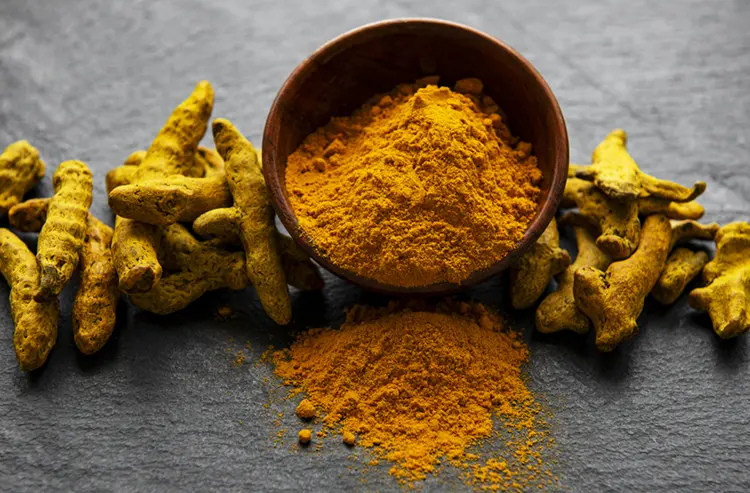
Turmeric is one of the most searched natural remedies for IBS. Its active compound, curcumin, has genuine anti-inflammatory and gut-protective properties supported by laboratory and animal research — and a growing clinical evidence base in humans. But curcumin also has a significant practical problem: taken as turmeric powder alone, almost none of it reaches your bloodstream. This article covers what the research actually shows, and critically, how to take turmeric so that it works.
What is Curcumin and Why Does It Matter for IBS?
Turmeric (Curcuma longa) is a flowering plant in the ginger family, widely used as a culinary spice in South Asian and Middle Eastern cooking. Its deep yellow-orange colour comes from a group of polyphenolic compounds called curcuminoids, of which curcumin is the most biologically active, making up approximately 2–5% of turmeric by weight.
Curcumin has attracted significant research interest for several properties relevant to IBS. It is a potent inhibitor of nuclear factor-kappa B (NF-κB), a key molecular switch controlling inflammatory gene expression — making it one of the most studied natural anti-inflammatory compounds. It also has antioxidant, antimicrobial and gut-motility-modulating properties, and has demonstrated mucosal protective effects in animal models of intestinal inflammation.
For IBS specifically, these mechanisms are relevant because low-grade intestinal inflammation, altered gut permeability and gut microbiome dysbiosis are increasingly recognised as features of the condition in a subset of patients — particularly in post-infectious IBS. Curcumin's anti-inflammatory and barrier-protective effects provide a plausible biological rationale for its potential benefit.
What Does the Clinical Evidence Show?
The most rigorous review of curcumin in IBS to date is a 2018 meta-analysis published in the Journal of Clinical Medicine by Ng et al., which systematically reviewed five randomised controlled trials and included three in the final analysis, covering 326 IBS patients in total.
The pooled analysis found that curcumin had a beneficial effect on IBS symptom severity compared to placebo, with a standardised mean difference of -0.466 (95% CI: -1.113 to 0.182). However, this result did not reach statistical significance (p = 0.158). The authors concluded that curcumin showed a "beneficial albeit not statistically significant" effect on IBS symptoms, and noted that the findings were limited by small sample sizes, heterogeneity between studies, and variability in curcumin preparations and dosing.
Notably, one of the included trials — a study using turmeric extract in patients with IBS — found significant improvements in abdominal discomfort and bowel habit satisfaction over 8 weeks compared to placebo. Another large observational study of 207 IBS patients treated with curcumin found significant reductions in abdominal pain and discomfort, though this study lacked a placebo control arm.
The honest assessment: the direction of evidence favours curcumin for IBS symptom relief, but the evidence base is not yet robust enough for a confident clinical recommendation. This is not unusual in the natural compounds literature — it reflects the need for larger, better-funded trials rather than an absence of biological plausibility. Curcumin's safety profile is excellent, with no adverse events reported across the available IBS trials.
The Bioavailability Problem — Why Turmeric Alone Doesn't Work Well
This is the most important practical consideration when discussing turmeric for IBS, and the one most frequently omitted from general health content. Curcumin is notoriously poorly bioavailable when taken orally on its own. It is rapidly metabolised in the liver and intestinal wall, and rapidly excreted. Studies using plain curcumin powder have found serum levels that are either undetectable or very low even at doses of 2 grams — meaning that relatively little of what you consume actually reaches the tissues where it needs to act.
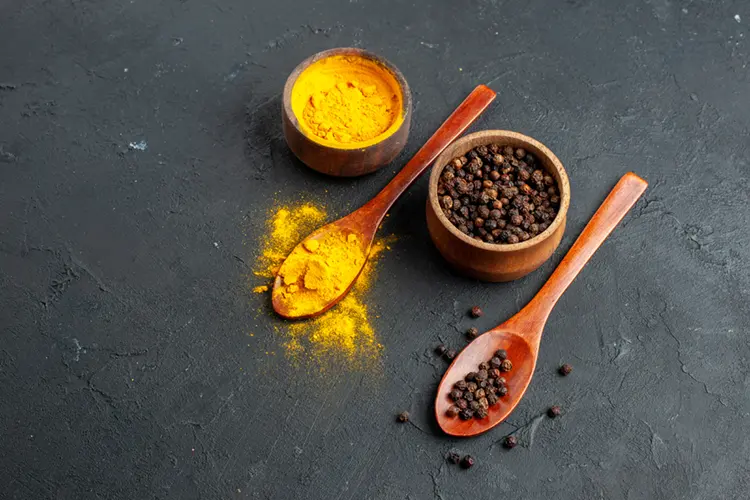
Simply stirring turmeric powder into food or water and consuming it delivers very limited curcumin to the body. The culinary use of turmeric in traditional cooking — typically combined with black pepper and fat-containing foods — is not coincidental. Both of these culinary co-factors significantly improve curcumin absorption, and understanding them is essential for anyone considering turmeric as an IBS supplement.
Black Pepper — The Critical Co-Factor
Piperine, the active alkaloid compound in black pepper (Piper nigrum), dramatically enhances curcumin bioavailability through several mechanisms. It inhibits CYP3A4 and UDP-glucuronosyltransferase — the liver and intestinal enzymes responsible for metabolising and clearing curcumin before it can be absorbed. By blocking these enzymes, piperine allows curcumin to remain in the body longer and reach significantly higher serum concentrations.
The magnitude of this effect was demonstrated in a landmark pharmacokinetic study by Shoba et al. (1998), published in Planta Medica. When 2g of curcumin was given alone to human volunteers, serum curcumin levels were either undetectable or very low. When the same dose was given alongside just 20mg of piperine — the equivalent of approximately a quarter teaspoon of black pepper — curcumin bioavailability increased by 2,000% at 45 minutes post-ingestion. This is one of the most striking bioavailability enhancement findings in the nutritional pharmacology literature.
A more recent study measuring curcumin in human urine (a proxy for absorption) confirmed the finding: co-administration with black pepper increased curcumin's half-life from 2.2 hours to 4.5 hours, and increased 24-hour urinary curcumin excretion from 49µg to 218µg. The practical implication is unambiguous: turmeric should always be consumed with black pepper to achieve meaningful curcumin absorption.
Fat — The Second Absorption Factor
Curcumin is fat-soluble, not water-soluble. This means it dissolves in dietary fat and is absorbed through the same pathway as fat-soluble vitamins (A, D, E, K) — via lymphatic transport from the intestine rather than direct portal absorption. Consuming turmeric with a meal containing fat significantly improves curcumin uptake compared to taking it in water or on an empty stomach.
This is why traditional South Asian culinary use of turmeric — incorporated into curries, dals and dishes cooked in ghee or oil, alongside black pepper — is mechanistically optimal for curcumin absorption, even without any pharmacological intent. For supplemental use, taking curcumin with a meal containing healthy fats (olive oil, avocado, nuts, oily fish) or alongside a fat-containing food is consistently recommended.
How to Take Turmeric for IBS — Practical Guidance
There are two approaches: culinary use and supplementation. Both have a role, and they are not mutually exclusive.
Culinary turmeric: Adding turmeric generously to cooked dishes alongside black pepper and healthy fats is a low-risk, nutritionally beneficial dietary habit. The curcumin dose delivered this way is lower than a supplement, but the absorption conditions are better than taking plain turmeric powder in isolation. Golden milk (turmeric, black pepper, fat-containing milk or coconut milk) is a practical daily format.
Curcumin supplements: For a more targeted approach, look for supplements that specifically address the bioavailability problem. The most studied formulations include: standardised curcumin extract with piperine (bioperine) added, phospholipid-complexed curcumin (such as Meriva, which has its own clinical trial evidence), and nanoparticle or liposomal curcumin formulations. Plain curcumin powder without any bioavailability enhancer is the least effective option. Typical doses used in clinical trials range from 500mg to 2g of curcumin daily, divided across meals.
Is Turmeric Safe for IBS?
Turmeric used as a culinary spice is recognised as safe. Curcumin supplements at doses used in clinical trials are also well tolerated — no adverse events were reported across the IBS trials included in the Ng et al. meta-analysis. Mild digestive effects (nausea, loose stools) have occasionally been reported at very high doses.
Important cautions: curcumin supplements may interact with anticoagulant medications including warfarin, and should be avoided at supplemental doses during pregnancy. Those with gallbladder disease should exercise caution as curcumin stimulates bile production. Always consult your GP before starting any supplement, particularly if you are taking other medications.
Where Turmeric Fits in IBS Management
Turmeric and curcumin sit in the same category as other natural compounds with mechanistic plausibility and early clinical promise but incomplete evidence — alongside peppermint oil (which has stronger trial data) and probiotics (whose evidence is strain-specific). The critical difference is that curcumin's efficacy is highly dependent on how it is consumed. A turmeric supplement without piperine and fat is unlikely to deliver meaningful curcumin to the gut. A well-formulated curcumin supplement with piperine, taken with food, is a reasonable addition to a broader IBS management approach — with the expectation of potential benefit rather than certainty.
For comparison of other evidence-backed options, see our articles on peppermint oil and IBS and probiotics and IBS.
Frequently Asked Questions
The evidence is promising but not yet conclusive. A 2018 meta-analysis found a beneficial trend for curcumin in IBS symptoms across three randomised trials, though the result did not reach statistical significance due to small sample sizes. Curcumin has well-established anti-inflammatory and gut-protective properties. It is safe and well tolerated, and may be a reasonable addition to an IBS management plan — but should not replace evidence-based first-line approaches such as dietary modification.
Piperine in black pepper inhibits the liver and intestinal enzymes that rapidly break down curcumin, allowing significantly more to be absorbed. A landmark study found that just 20mg of piperine taken with 2g of curcumin increased bioavailability by 2,000% in humans. Without black pepper, very little curcumin from turmeric reaches the bloodstream in meaningful quantities.
Turmeric as a food spice is safe. Curcumin supplements are well tolerated in clinical trials with no significant adverse events reported in IBS studies. However, supplements may interact with anticoagulant medications and are not recommended at supplemental doses in pregnancy. Consult your GP before starting any supplement.
Clinical trials have used curcumin doses ranging from 500mg to 2g daily, typically divided across meals. For culinary use, there is no established therapeutic dose — but consistent daily use with black pepper and fat-containing foods is the practical aim. For supplemental use, a standardised curcumin extract with piperine (bioperine) added is the most practical formulation for improving absorption.
IBS.ie
Ireland's dedicated IBS information resource. We provide evidence-based, HSE and PubMed-referenced content on irritable bowel syndrome — covering symptoms, diet, gut health and management. All content is for general information only. Always consult your GP or a qualified specialist for personal medical advice.
Related Articles
Sources & References
Ng, Q.X., et al. (2018). A Meta-Analysis of the Clinical Use of Curcumin for Irritable Bowel Syndrome (IBS). Journal of Clinical Medicine. View on PubMed ↗
Shoba, G., et al. (1998). Influence of piperine on the pharmacokinetics of curcumin in animals and human volunteers. Planta Medica. View on PubMed ↗
Anand, P., et al. (2007). Bioavailability of Curcumin: Problems and Promises. Molecular Pharmaceutics. View on PMC ↗
Opara, E.I., et al. (2023). Effect of pepper on curcumin bioavailability — urinary LC-MS/MS study. Journal of Food Science. View on PMC ↗
HSE. Irritable Bowel Syndrome. View on HSE.ie ↗
